
About Your Midichlorian Count....
Have More Than Master Yoda You Shall.

The Midichlorian Count Is Just Bioenergetic Capacity
In Star Wars, a higher Midichlorians count means greater connection to the Force.
In medicine, a higher density and function of mitochondria means better:
Energy production
Cognitive clarity
Muscle performance
Recovery capacity
We just don’t draw blood and say, “Congratulations, you’re a Jedi.”
We say, “Your VO₂ max is excellent and your mitochondria are doing their job.”
Same idea. Worse marketing.
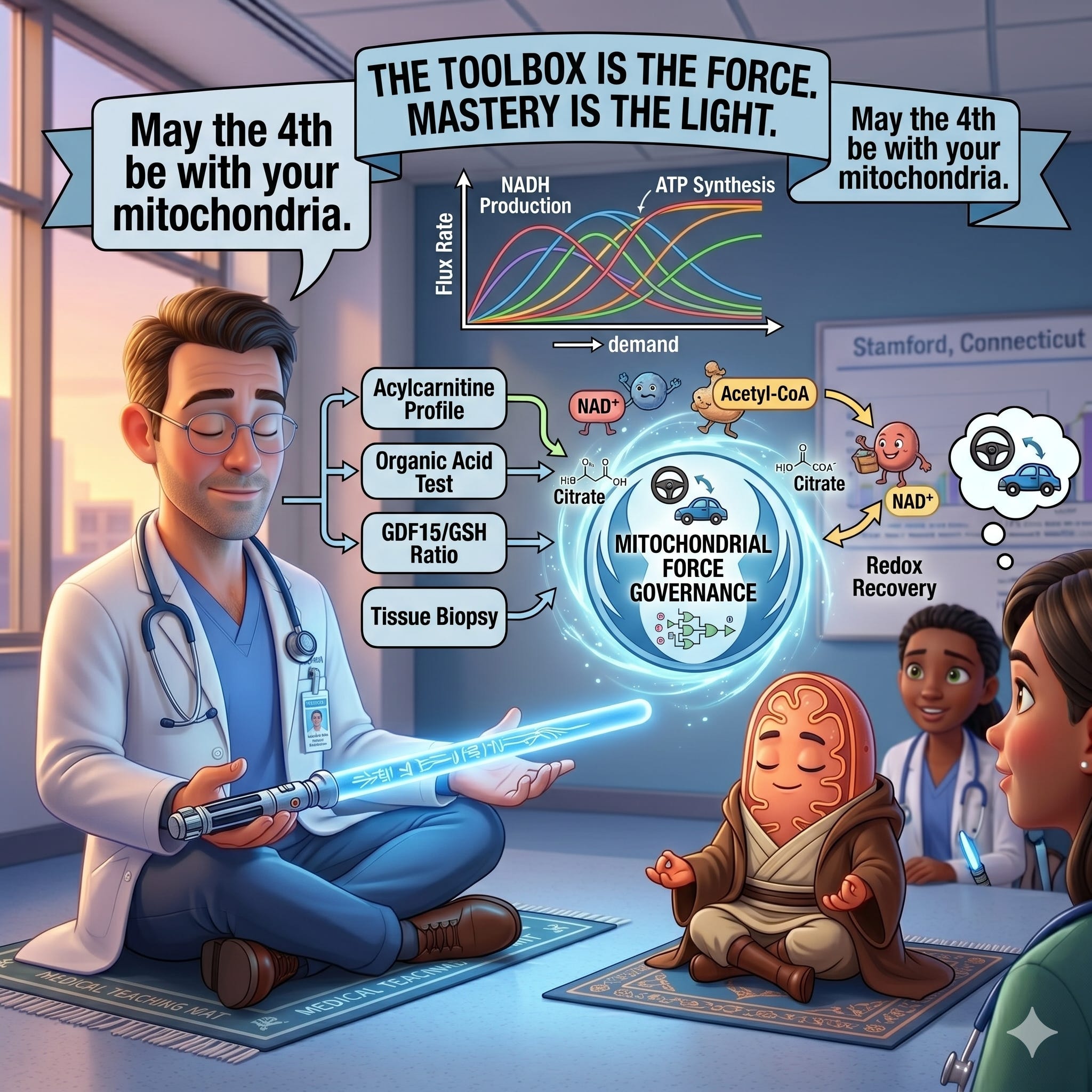
Mitochondria generate ATP at a scale glycolysis could never touch. Without them, you’re stuck producing a couple ATP per glucose. With them, you’re pushing 30-plus . That difference is the gap between a sedentary human and someone who looks like they could outrun a stormtrooper patrol.
The original Star Wars idea of Midichlorians wasn’t just a quick explanation for who can use the Force, it was an attempt to explain why some people are more powerful with it - why some have a stronger connection, and don’t all respond to training the same way. This is exactly how our bodies work.

How many Midichlorians you have in the films seems fixed, like something you’re born with.
But in reality, your mitochondria (which are like Midichlorians) are both something you get from your parents and something you can improve. You inherit your mitochondrial DNA, how well they work at a basic level, and certain ways your metabolism tends to behave.
“You Will Subscribe To The Longevity Insider with Doctor Murphy”
However, you develop mitochondrial density, how efficiently they use oxygen, and how well they withstand stress. Mitochondria are always changing, splitting, joining, making copies of themselves and breaking down - they react to what you do each day, so your “Midichlorian count” is much more like your heart health than your eye color, it’s something that changes.
And it’s not just how many you have, but how good they are. You can have lots of mitochondria and still not be functioning well if they aren’t very efficient. Having more is the potential, but better mitochondria equal actual performance.
They create ATP (energy) through a process called oxidative phosphorylation, which makes a lot more energy than the simpler glycolysis. But oxidative phosphorylation needs working electron transport chains, healthy membranes, and correct communication. When these systems fail, energy leaks out, damaging chemicals (reactive oxygen species) increase, and signalling goes awry. You lose not just energy, but control - that’s not a low count of Midichlorians, it’s damaged ones.

The movies touched on this, but didn’t explore it: Midichlorians “talk” to the Force. Mitochondria do something similar. They aren’t just storing energy, they sense things - nutrient levels, oxygen, stress, your body clock - and then change how the cell behaves. Some scientists even call them a central hub that coordinates many biological processes, essentially being the link between you and your surroundings.
They don’t just create energy, they decide how that energy is used.
When a Jedi “feels a disturbance” in the Force, they are sensing very subtle changes. And biologically, mitochondria are involved in regulating calcium flow, redox signalling, the immune system and programmed cell death (apoptosis). They help decide if a cell lives, changes, or dies.

Looking at the bigger picture, this translates to whether tissues heal, inflammation goes down, or a disease gets worse. So the Force, without the mythology, looks a lot like a complicated signalling system mostly managed by how well your mitochondria are working.

The films see being out of balance with the Force as a matter of morality or philosophy. I views it as mitochondrial problems, and these problems are linked to neurodegeneration, metabolic illness, constant tiredness, and faster ageing. In fact, mitochondrial issues are a key part of how we get old. When these systems deteriorate, energy levels fall, repair systems fail, and old, damaged cells build up. You don’t fall to the Dark Side, you become frail.
Can you increase your Midichlorian count? Yes, but not in the way people imagine. There’s no quick fix, no ceremonial use of a lightsaber. What does work is predictable and, honestly, not very glamorous: repeatedly pushing your metabolism (exercise), restricting your eating at times (fasting), sticking to a regular body clock (sleep schedule), and getting the building blocks and helpers mitochondria need. These things encourage mitochondrial biogenesis (making more), better efficiency in how they use oxygen, and improved ability to handle stress. Simply put, you increase both the number and the quality of your Midichlorians.
As we age, this system slowly breaks down, cells become less efficient, accumulate damage, and become old and inactive. Our physical ability declines with time, and this is largely due to our mitochondria. So when someone says they have “low energy”, they aren’t being vague. They’re describing a real, measurable biological fact: their Midichlorian count is falling, or, even worse, their Midichlorians aren’t working properly.

The initial concept of Midichlorians wasn’t incorrect, it was just oversimplified. What they were trying to portray is that some people are more capable of creating, controlling, and directing energy in response to stress and their surroundings. That isn’t a mystical ability. It’s mitochondrial biology. So, if you’re going to celebrate May the Fourth, perhaps a better question to ask is: “What is my Midichlorian count, and what am I doing to make it better?”
Here are my top tips
Top 5 Ways to Boost Your “Midichlorian Count”
If we strip away the mythology, you’re trying to do one thing:
Increase the number and performance of your mitochondria.
That’s mitochondrial biogenesis plus efficiency. And there are only a handful of interventions that reliably move that needle.
Zone 2 Cardio (The Jedi Foundation)
This is non-negotiable.
Steady-state aerobic training at a pace where you can still hold a conversation drives:
Mitochondrial biogenesis
Increased capillary density
Improved fat oxidation
Mechanistically, this activates AMPK and PGC-1α, the master regulators of mitochondrial creation.
Think of it as building more Midichlorians, not just pushing the ones you have.
Do it 3–5x per week. No shortcuts here.
High-Intensity Intervals (Stress the System but not too much)
If Zone 2 builds the engine, intervals test it under fire.
Short bursts of high intensity:
Increase mitochondrial efficiency
Improve electron transport chain function
Enhance metabolic flexibility
You are forcing mitochondria to operate at peak demand.
This is where adaptation happens.
One or two sessions per week is enough. More is not better. That’s how people burn out their “Force reserves.”
Fasting and Metabolic Flexibility (Starve the System, Strategically)
Mitochondria thrive when energy is not constantly abundant.
Intermittent fasting or time-restricted eating:
Activates autophagy and mitophagy
Clears damaged mitochondria
Forces reliance on oxidative phosphorylation
Remember, mitochondria exist to efficiently generate ATP. When you constantly feed the system, you default to glycolysis and blunt that machinery.
Fasting brings the system back online.
Cold Exposure (Controlled Environmental Stress)
Cold is a powerful mitochondrial stimulus.
It:
Activates brown fat
Increases mitochondrial density
Enhances uncoupling proteins
You are essentially forcing mitochondria to generate heat instead of just ATP.
That inefficiency is useful. It builds capacity.
Cold showers, ice baths, or even just getting outside in the cold works. It doesn’t need to be extreme to be effective.
Sleep and Circadian Alignment (Where the Real Repair Happens)
This is the most ignored lever, and it’s not optional.
Mitochondria are tightly linked to circadian rhythms. Disruption affects:
Energy production
Hormonal signaling
Redox balance
Mitochondrial function and circadian biology are intertwined at a fundamental level .
If your sleep is poor:
You don’t repair damaged mitochondria
You accumulate oxidative stress
You blunt adaptation from everything else on this list
You can train hard and fast all you want. Without sleep, your Midichlorian count declines.
Bonus (Because You’ll Ask Anyway)
Supplements that support but do not replace the above:
CoQ10
NAD+ precursors
L-carnitine
Magnesium
Urolithin A
They help the machinery. They don’t build it.
Remember This!
Your “Midichlorian count” is not a gift. It’s a system.
You increase it by:
Applying stress
Allowing recovery
Repeating consistently
Do that well, and your mitochondria expand, adapt, and perform.
Do it poorly, and you end up tired, inflamed, and wondering where the Force went.
It didn’t go anywhere.
You just stopped training it.
To A Life Well Lived, and May The 4th Be With You, Always
-Dr. M


✅