

Light, Rhythm, and Repair: Lessons from the Longevity Docs Peptide Conference (Part 2)
The Science of Photobiomodulation and the Seasonal Body
Our second day at the Longevity Docs Peptide Mastermind opened like a sunrise fitting for a meeting that spent the morning talking about light.
The lectures from Dr. Elizabeth Yurth, Dr. Abid Hussein, and Dr. Neil Paulvin built on yesterday’s foundation and moved us toward something deeper: understanding how light, peptides, and time itself interact to heal and regenerate the body.
Want to learn more? Remember to Subscribe and get the case studies, education and insider track for Longevity.
Dr. Elizabeth Yurth: Light, Seasons, and the Circadian Reset
Dr. Yurth of the Boulder Longevity Center delivered a session that could have been titled “The Physics of Healing.” Her focus was photobiomodulation: the clinical use of near-infrared and red light to modulate mitochondrial function and how it intersects with our peptide cycles.
Photobiomodulation (PBM) works by stimulating cytochrome c oxidase within the electron-transport chain. When photons in the 600–1100 nm range hit this enzyme, they displace nitric oxide, allowing oxygen to bind and ATP production to rise. The downstream effects, enhanced mitochondrial respiration, reduced reactive oxygen species, and improved microcirculation, translate clinically to faster wound healing, lower inflammation, and improved energy metabolism.
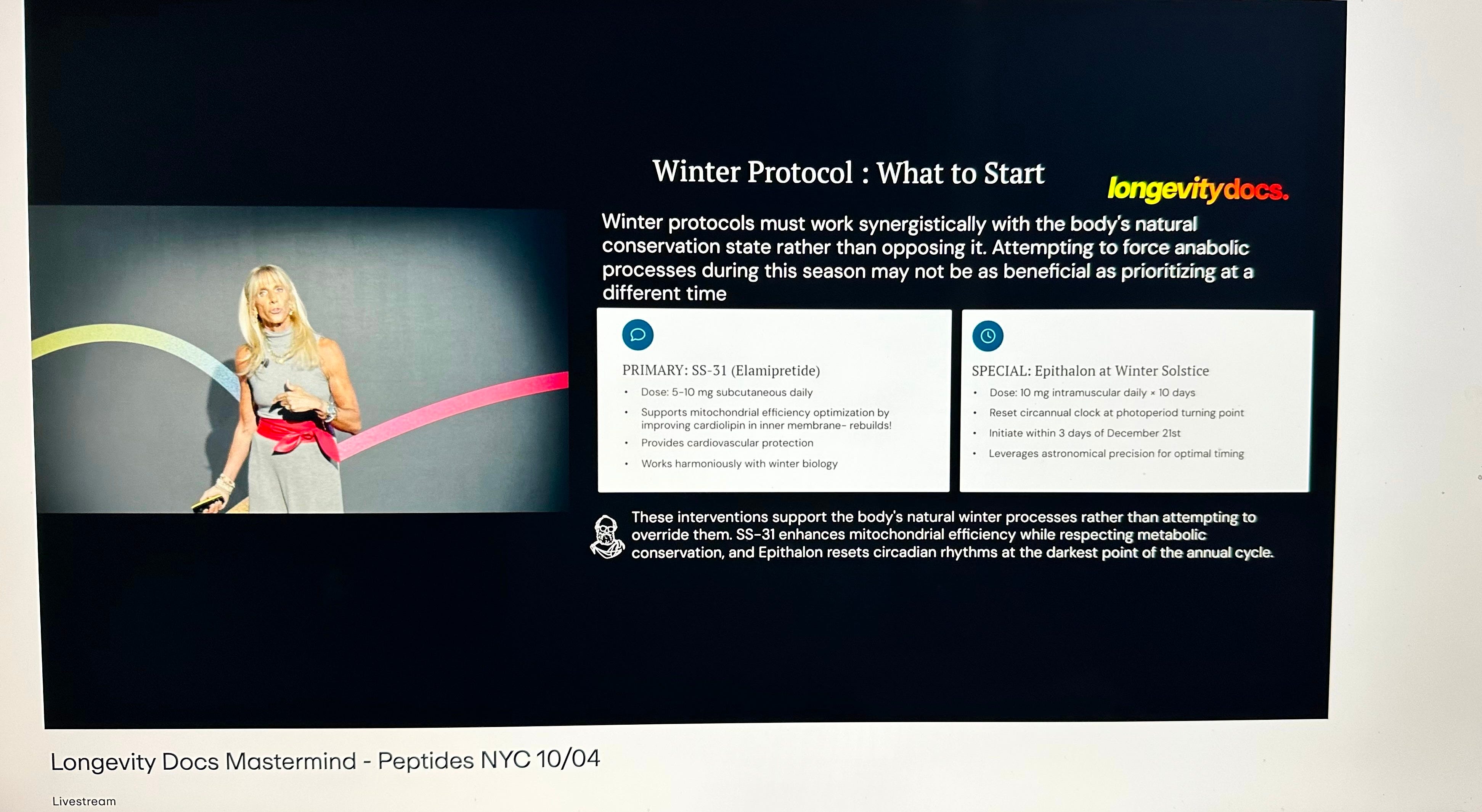
But Yurth’s genius is how she connected PBM to seasonal biology. Humans, she reminded us, are rhythmic creatures:
Spring/Fall = Build: growth hormone secretagogues, MOTS-C, GHK-Cu, thymosin α1.
Summer/Winter = Repair and Sustain: SS-31, epitalon, and restorative light exposure.
She recommended timing epitalon at the two solstices, 10 mg nightly for 10 days, to synchronize melatonin cycles and “re-entrain the cellular clock.”
This seasonal strategy, combined with daily light exposure in the morning and infrared therapy in the evening, creates what she calls a circadian reset: mitochondria, peptides, and hormones working in phase rather than in competition.
Her message to clinicians was simple but radical: not every peptide belongs in every season.
By syncing interventions with light and circadian cues, we respect the body’s ancient rhythm and avoid the “always-on” metabolic noise that leads to burnout and disease.
Brilliant right? So now share this with your friends and family!
Dr. Abid Hussein: The Mitochondrial Heart
Cardiologist Dr. Abid Hussein took the stage next and brought that same light-based logic to the heart. His topic: SS-31 and vascular repair, underscored how photobiomodulation and mitochondrial peptides share a common goal: preserving cardiolipin, the phospholipid scaffold of the inner mitochondrial membrane.
SS-31 (elamipretide) binds to cardiolipin, stabilizing mitochondrial cristae, reducing reperfusion injury, and preventing arrhythmias. Hussein proposed something bold: pairing SS-31 with TB-4 (thymosin β4) or its fragment TB-500 in acute cardiac settings to prevent post-ischemic scarring. He also revisited BPC-157, calling it the ultimate vascular peptide, promoting angiogenesis and endothelial remodeling without increasing cancer risk, contrary to old concerns.
His takeaway: the next generation of cardioprotection will be mitochondrial, not mechanical.
Dr. Neil Paulvin: The Library and the Lessons
The morning closed with Dr. Neil Paulvin, who somehow condensed the peptide universe into a single hour. He addressed the practical side of precision therapy, what works, what doesn’t, and what’s sustainable.
Paulvin reminded clinicians that enthusiasm must meet realism. Cerebrolysin, for example, can improve neurodegeneration but demands daily IV therapy for weeks. More importantly, he cautioned: before writing prescriptions, make sure your patient isn’t needle-phobic…..because compliance beats complexity every time.
His pragmatic point hit home: start with FDA-approved foundations: tesamorelin, SS-31, semaglutide, or tirzepatide, then layer additional peptides only when the fundamentals of circadian rhythm, diet, and light are optimized.
Bringing It All Together
If the first session was about promise, the second was about precision.
Dr. Yurth showed us that light is medicine when timed correctly.
Dr. Hussein demonstrated that the heart’s longevity depends on mitochondrial integrity.
Dr. Paulvin reminded us that complexity is the enemy of compliance.
Together, they framed a unified message:
Regenerative medicine isn’t about stacking peptides….it’s about synchronizing biology.
Light first, rhythm second, molecule third.
As the conference continues, I’ll cover how the afternoon sessions explored senescence, autophagy, and the next wave of clinical peptide protocols.
For now, step outside, catch the morning sun on your retina, and remember: your mitochondria are listening.
To A Life Well Lived,
-Dr. M
Concierge Medical Associates | Longevity Insider Substack


