
Why This Peptide Docket Looks Like Regulatory Science
BakerHostetler Is not playing around here.

There are moments when an entire field quietly crosses a threshold.
Not because a miracle therapy appears. Not because a landmark clinical trial changes practice overnight. And not because regulators suddenly become more receptive.
The threshold is crossed because the conversation itself changes.
For much of the past decade, peptide medicine has lived in an uncomfortable space between scientific plausibility and regulatory skepticism. Physicians saw remarkable clinical responses. Basic scientists continued to uncover new biological pathways. Patients shared experiences that traditional medicine often struggled to explain. Yet from the FDA’s perspective, much of the evidence remained fragmented. Mechanistic papers are not manufacturing validation. Case reports are not controlled evidence. Clinical enthusiasm is not quality assurance.
Those are fair criticisms.
Regulators are not tasked with deciding whether an idea is exciting. They are tasked with deciding whether a product can be manufactured consistently, identified accurately, monitored appropriately, and used with an acceptable balance of benefit and risk.
Those are fundamentally different questions.
Today I will be reviewing the public data released in the documents for the PCAC hearing. Make no mistake, these documents were assembled by a seasoned litigtaion and regulatory law team at BAKER/HOSTETLER
That distinction is precisely why I found the recent AAPM submissions to the FDA’s Pharmacy Compounding Advisory Committee so interesting. Literally, like a bomb drop on the AAOS template letter saying “ we don’t have any data to use this”…like they did with PRP.
Reading through hundreds of pages of analytical chemistry, manufacturing standards, impurity analyses, physician utilization data, pharmacovigilance reports, stability testing, and legal arguments, I realized this was no longer simply a debate about peptides.
It was a demonstration that the peptide field itself has evolved.
Over the past several days I worked through what can only be described as one of the most important regulatory document collections the peptide community has ever assembled.
Not a press release.
Not a collection of opinion pieces.
The submission consisted of hundreds of pages of briefing documents prepared for the FDA’s Pharmacy Compounding Advisory Committee. Collectively, these materials include scientific reviews, analytical chemistry reports, manufacturing and quality control data, impurity analyses, pharmacology, toxicology, physician utilization surveys, adverse event reporting, legal arguments, public comments, and regulatory position papers from physicians, scientists, compounding organizations, manufacturers, and professional societies.
In total, I reviewed well over 700 pages of material.
It is the closest thing to a whole body MRI of the current peptide field that I have seen.
Whether the committee ultimately agrees with every conclusion is almost beside the point.
For the first time, a large segment of the regenerative medicine community has attempted to meet the FDA on its own ground.
Instead of asking regulators to trust physician experience alone, the submissions attempt to answer the questions regulators are actually trained to ask: What is the active ingredient? How pure is it? How reproducible is manufacturing? What are the impurities? What is the real-world safety profile? How many patients have actually received these therapies? What evidence supports physician demand? What unmet medical need remains?
Those are the language of pharmaceutical regulation, not conference lectures or social media debates.
That change matters.
Do you want to know what’s in there? Subscribe. It is the best way we can bring you cutting edge Longevity Insider information.
In many ways, it represents the coming of age of peptide medicine itself. The field is beginning to recognize that if it wants a permanent place within modern medicine, it must compete not only on biological promise, but on analytical rigor, manufacturing quality, regulatory transparency, and evidence generation.
That is how every therapeutic class eventually earns legitimacy.
Whether these particular peptides remain available for compounding will ultimately be determined by the FDA. But regardless of the outcome, these submissions reveal something larger.
The peptide community is no longer asking to be treated differently.
It is asking to be judged by the same scientific standards as everyone else.
And that may prove to be the most consequential development of all.
The core claim holds, with one important caveat
The submission package does support the central thesis that this is a more mature phase of peptide advocacy. The strongest reason is structural: the materials are not organized as a broad defense of “peptide based medicine,” and they are not mainly trying to overwhelm the reader with mechanistic promise.
They are organized as a formal response to the FDA’s own decision framework for Section 503A bulk drug substances. The executive submission, filed by BakerHostetler on behalf of AAPM for the July 23–24, 2026 Pharmacy Compounding Advisory Committee meeting, explicitly frames the case around the four criteria in 21 CFR 216.23(c), then backs that framework with a curated exhibit stack: chemistry, clinical monographs, manufacturing quality, prospective studies, real-world safety, utilization history, and institutional support.
That is a very different rhetorical posture from the looser, benefits-first style that often surrounds peptide discourse.
The caveat is that the phrase “five years ago” is interpretive. The docket itself does not prove what the field looked like in 2021. What it does prove is that this submission has been consciously engineered to answer FDA’s questions on FDA’s terms.
That is enough to sustain the larger point. And the timing matters: FDA staff publicly signaled before the meeting that they see little evidence to support compounding of these seven peptides, while the July PCAC meeting is set to consider whether they should be added to the bulk substances list; the committee’s recommendations are influential but non-binding.
How the FDA Could Redraw the Future of Longevity Medicine

For years, peptides have existed in one of medicine’s grayest zones. They have been embraced by longevity physicians, dismissed by skeptics, promoted by influencers, compounded by specialty pharmacies, and purchased from anonymous websites around the world. Yet despite all of the debate, one question has remained largely unanswered:
The package has been built to survive FDA’s frame, not the internet’s
The best evidence of maturation is the way the submission has been assembled. The executive summary does not start with testimonials, celebrity use, or generalized claims that peptides are “natural.”
It starts with the governing criteria: physical and chemical characterization, safety, evidence of effectiveness, and historical use in compounded drug products. It then presents a substance-by-substance analysis and supporting exhibits to show that the record, in AAPM’s telling, now satisfies each criterion for BPC-157, KPV, TB-500, MOTS-C, Emideltide, Semax, and Epitalon, including their free-base and acetate variants.
That matters because it changes the submission from a persuasion document into something closer to an administrative record. Even the language is bureaucratically calibrated. The executive summary repeatedly returns to terms like “identity,” “purity,” “related substances,” “residual solvents,” “endotoxin,” “critical quality attributes,” “material qualification,” and “historical use.” Those are not the usual nouns of peptide marketing. They are the nouns of regulatory chemistry and compounding oversight.
This is why the claim that the field is “no longer arguing on its own terms” is basically right. The core move here is not, “trust clinicians who say these work.” The core move is, “we understand the Agency’s balancing test, and we have tried to close the exact gaps the Agency identified.” Whether FDA agrees is a separate issue. But the argumentative posture has clearly shifted.
The sharpest sign of maturation is the move from efficacy talk to control talk
The strongest part of the package is not the clinical monographs. It is the move into chemistry, sourcing, and manufacturing controls.
In the executive summary, AAPM points to an analytical framework that, for BPC-157, confirms identity by mass spectrometry and HPLC, quantifies purity and related substances, and controls residual solvents, water, counterion, bioburden, and endotoxin. The same summary says those methods were developed using USP and ICH-oriented standards and are being transferred to FDA-registered U.S. facilities, with drug master files planned by year-end. That is the language of a CMC argument, not a wellness argument.
The Revelation Pharma manufacturing report pushes this even further. It acknowledges that these peptides lack applicable USP monographs and are not components of FDA-approved drugs, then argues that this gap can be managed through a dosage-form-driven qualification framework rather than treated as fatal. Revelation says it has identified FDA-registered API manufacturers for all seven substances, and describes supplier qualification steps that include checking FDA registration status, inspection history, import alerts, warning letters, and certificate-of-analysis consistency.
It also sets out the critical quality attributes it treats as essential for injectable use: identity and assay, organic and inorganic impurities, peptide aggregates, elemental impurities, residual solvents, water content, microbial limits, bacterial endotoxin testing, and stability.
That is exactly what a mature regulatory response looks like. It does not ask FDA to ignore uncertainty. It tries to convert uncertainty into a managed quality system. In other words, the submission is implicitly conceding FDA’s main point: for peptides, the central problem is not only whether a molecule may have biological activity, but whether it can be reproducibly characterized, sourced, tested, and compounded under controlled conditions. The submission’s answer is that these problems are operational and solvable.
There is also a very important limit here. Revelation’s own report says supplier qualification remains “in process,” including resolution of open regulatory correspondence and registration confirmation. So the chemistry case is more serious than older peptide advocacy, but it is not finished. The report is saying, in effect, “the infrastructure exists or is emerging,” not “every qualification issue is already closed.” That distinction matters.
The safety section looks more like pharmacovigilance than folklore
Another major change is the effort to put denominators under the safety case.
Exhibit I compiles utilization and adverse-event information from six manufacturers and five clinics. It reports 2,013,809 discrete medication units containing at least one of the seven nominated substances, which the report translates into more than 20 million doses. Using an ingredient-level count, the dataset rises to 2,359,374 peptide-containing unit counts, or more than 23 million doses. That is an attempt to move the discussion away from “lots of doctors use this” and toward a more surveillance-like question: how much exposure has actually occurred, across what timespan, and with what signal profile.
The same exhibit reports very low passive adverse-event rates in the manufacturer data it received. One manufacturer reported 6 adverse events among 258,708 BPC-157-containing units, 7 among 189,705 TB-500-containing units, and 3 among 45,401 MOTS-C-containing units, with those events largely limited to hypersensitivity-type reactions such as rash, allergic reaction, or injection-site lump. Clinic-level data were similarly sparse, with one clinic reporting only a single mild BPC-157-associated eczema flare among its peptide-related units.
That is not a randomized-trial safety package. But it is unmistakably an attempt at pharmacovigilance logic: estimate exposure, identify events, compare frequencies, and contextualize them against more established therapeutics. The executive summary makes that strategy explicit by contrasting the reported event burden for the nominated peptides with higher adverse-event frequencies reported in the literature for approved peptide and protein therapeutics such as insulin, somatotropin, semaglutide, and tirzepatide.
Exhibit E shows the same mindset. It is a prospective observational study of patient-reported outcomes for compounded glycine/tirzepatide, included not as direct proof that the seven nominated peptides are safe, but as a real-world comparator for a different compounded peptide prescription already in use. The methodology is explicitly described as descriptive rather than causal: 1,778 patients enrolled, 177 respondents, external comparator drawn from 16 tirzepatide publications, internal confidence intervals shown with Wilson methods, and a warning that the comparison does not establish comparative efficacy or safety.
Crucially, the exhibit also discloses an unfavorable result rather than burying it: fatigue was above the published comparator range. That kind of adverse disclosure is another sign that the package is at least trying to look like regulatory science instead of pure advocacy.
That said, the limitations are real and the exhibit admits them. The comparator is not concurrent or historical control. The outcome data are patient-reported. The response fraction is low. And the nominated peptides’ safety data remain dominated by passive, heterogeneous reporting rather than active trial-style surveillance. So the package has matured methodologically, but it has not escaped the basic evidentiary weakness of the category.

The clinical evidence is more targeted than before, but it is still uneven
The clinical layer has matured too, just less decisively than the chemistry and safety layers.
The clearest example is BPC-157. Exhibit D includes two prospective, IRB-approved clinical studies from my friend Dr. Edwin Lee’s group. One enrolled 71 participants across three clinics who received compounded BPC-157 with or without thymosin beta-4 for musculoskeletal injury; 66 completed follow-up, pain improved significantly by four weeks, and no major complications or adverse effects were reported. The second was a prospective randomized postoperative study of intra-articular BPC-157 in knee and shoulder arthroscopy patients, with 33 patients in analysis and no reported adverse events through one-year follow-up.
Even if a regulator remains skeptical about study design, sample size, or endpoint quality, this is plainly more focused than generic “healing peptide” rhetoric. AAPM is no longer just saying that BPC-157 has promising animal data. It is trying to put human tolerability and outcome signals into the record, under IRB approval, with identifiable manuscripts. Exhibit I also folds those studies into a broader literature review that includes retrospective human work in knee pain, interstitial cystitis, and intravenous infusion tolerability.
The rest of the clinical case is weaker and more heterogeneous. The monographs in Exhibit B provide substance-specific therapeutic rationale, proposed uses, dosing, and literature citations for each peptide, which helps create a dossier-like feel. But they also reveal the package’s remaining hybrid character. The BPC-157 monograph, for example, reads partly like a reference sheet for practitioners, including common uses, suggested doses, and “IPS Level of Evidence” labeling, not just a neutral evidence synthesis. That does not make it useless. It does mean the clinical exhibit stack still carries visible advocacy and field-building DNA.
That unevenness matters because FDA is not reviewing a generalized peptide category. The July meeting concerns seven peptide families for specific nominated uses, and staff reviewers have already publicly indicated skepticism about the evidence base for compounding them. So one of the strongest arguments in this thesis is also one of the easiest to overstate: the field has matured procedurally, but the human clinical record is still substantially more developed for some substances than others.
The package is also trying to solve a policy problem, not just a peptide problem
Another sign of maturation is that the submission does not confine itself to molecule-by-molecule pleading. It tries to articulate a regulatory philosophy.
The executive summary argues that inclusion on the 503A list would not constitute FDA approval, but would return these substances to regulated compounding channels, under patient-specific prescriptions and pharmacy quality controls. It explicitly reframes the central public-health question as one of channel management: physician-supervised compounding versus unregulated gray-market supply.
That same framing appears in the support letters. The veterans and military exhibit argues that removing regulated access did not eliminate demand and instead redirected veterans and service members toward unregulated online and gray-market sources without assured identity, purity, potency, sterility, physician oversight, or adverse-event monitoring.
The LECOM letter makes a related academic argument: keeping these therapies inside the regulated 503A pathway is what allows the medical and scientific community to evaluate them, whereas self-administration from gray-market sources produces no structured evidence base at all. The domestic-manufacturing letter adds a supply-chain and industrial-policy layer, arguing that a legitimate pathway would bring sourcing, fill-finish, and quality control onshore rather than leaving responsibility diffused across foreign suppliers.

The white paper goes even further by proposing a peptide-specific, risk-based framework. It explicitly rejects biologics-level evidentiary burdens for every peptide and instead proposes a three-tier system: Tier 1 for endogenous or near-endogenous peptides with cGMP manufacturing, identity/purity/potency testing, basic toxicology, and mandatory pharmacovigilance; Tier 2 for modified or stabilized peptides with added toxicology, pharmacokinetics, and limited human safety studies; and Tier 3 for novel synthetic peptides requiring full phased clinical development and standard NDA or BLA pathways. Whether one agrees or not, that is a policy architecture, not a product pitch.
This is a crucial part of this argument. The peptide field here is not merely asking for mercy on seven substances. It is trying to show FDA what a more durable peptide governance model could look like. That is institutional maturation.
The record is more sophisticated, but it is not yet clean enough to guarantee persuasion
A mature record is not the same thing as a winning record.
The first weakness is that some of the strongest chemistry claims in the executive summary point to Exhibit A, the analytical package from ARL Bio Pharma, in this review it is partly second-order: we can see how AAPM characterizes the analytical package, but not fully inspect the raw underlying exhibit itself.
The second weakness is that the safety case is still structurally fragile. Exhibit I itself acknowledges that direct incidence comparisons to approved peptide drugs are limited because the nominated substances’ data rely disproportionately on passive reporting, while the approved-drug comparators come from trials, registries, and meta-analyses with active adverse-event capture. That is exactly the sort of limitation FDA staff tend to emphasize, and Reuters reported that staff reviewers had already highlighted limited human evidence and safety concerns ahead of the meeting.
The third weakness is that the package is strongest for BPC-157 and weaker by extension for the rest. The prospective human studies are BPC-centric. The monographs broaden the record, but they do not create symmetry of evidence across all seven candidates.
A skeptical regulator can still say: this may be a better dossier than what existed before, but it does not erase the mismatch between strong operational controls and thin direct human evidence for several substances.
The fourth weakness is tonal. Parts of the record unquestionably read like regulatory science. Other parts still read like movement documents. That is especially true in the clinical monographs and support letters, where the case sometimes leans into clinical promise, patient demand, and philosophical objections to applying commercial-trial standards to individualized compounding. Those arguments may be politically useful. They are not the same thing as closing a scientific gap. I believe many in the industry will laud these documents, including myself. But I do acknowledge cheerleading is in this submission.
“Don’t Lose Your License”: What Clinicians Really Asked Me About Peptides

I Spoke at the Integrative Healthcare Symposium over the weekend. I was on the last day, so I had the benefit of listening to dozens of other lecturers, ingesting their content, considering the evide…
The right conclusion
So the best version of the argument is not that the peptide field has suddenly become fully evidence-secure. It has not.
The better argument is that this submission shows a real change in how the field is presenting itself. The center of gravity has moved away from mechanistic enthusiasm and physician anecdote and toward a recognizable FDA-style dossier: four-factor framing, substance-specific analysis, analytical characterization, supplier qualification, CQA logic, real-world exposure estimates, adverse-event denominators, targeted prospective human data, and a proposed risk-based policy framework.
The paperwork shows a field trying to prove that it understands what regulators actually care about: not just whether a peptide is interesting, but whether uncertainty can be bounded through identity testing, impurity control, sourcing discipline, physician supervision, pharmacovigilance, and a legally intelligible standard for compounding.
If you want the blunt version, it is this: the science is still mixed, the record is still uneven, and FDA may still say no. But the paperwork itself is not amateur hour. It is a serious attempt to convert peptide culture into regulatory argument. That, more than any single molecule, is the real sign of maturation in this docket.
After reading the FDA briefing books alongside the AAPM/BakerHostetler submission, I think the sponsors materially improved their position. I do not think they completely overcame FDA’s institutional advantage.
If I were handicapping this like a Supreme Court oral argument, here is where I would put it.
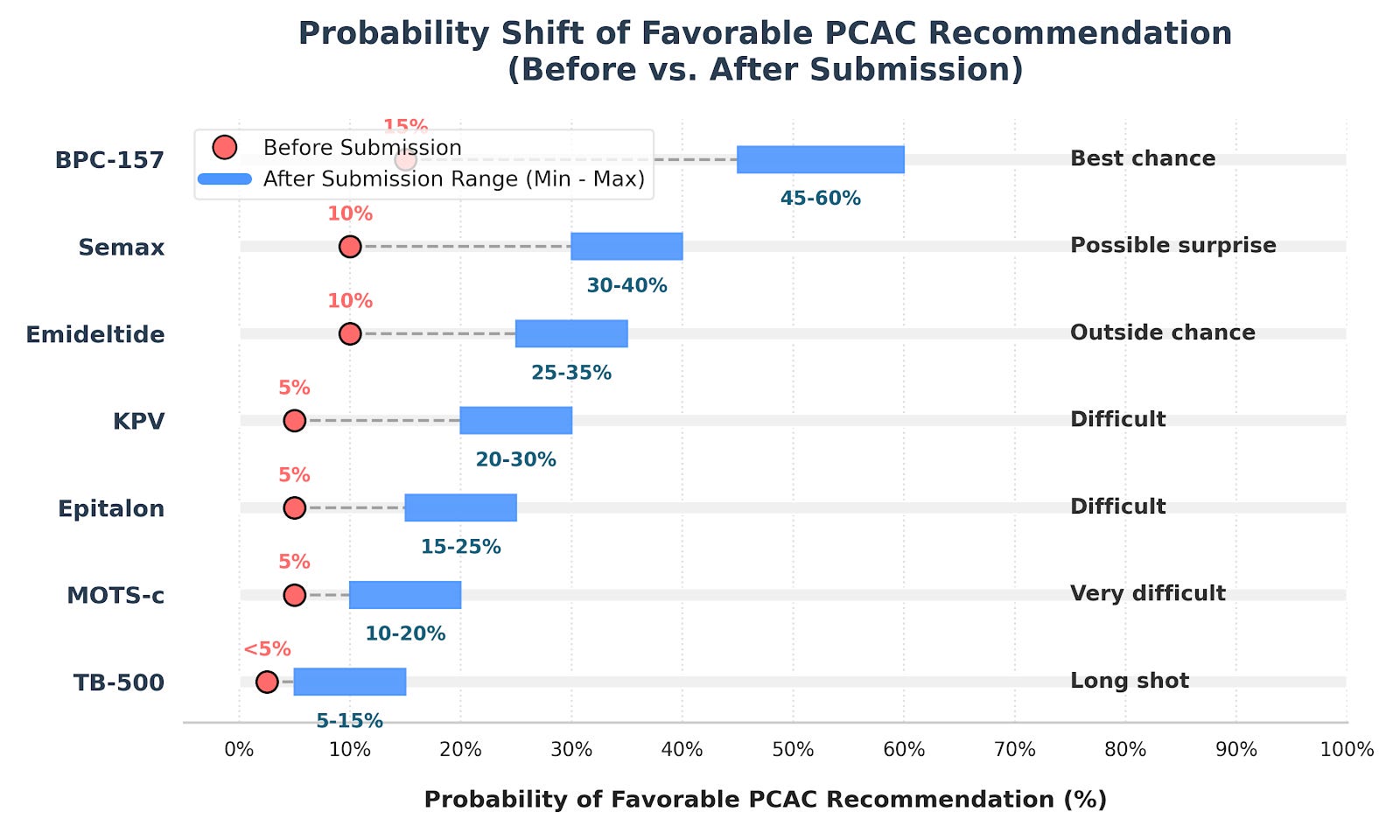
Why BPC-157 Has the Best Chance
Of all the peptides under review, BPC-157 appears to have improved its position the most. FDA’s concerns were never simply about whether BPC-157 might work. They centered on limited human evidence, manufacturing consistency, product characterization, injectable safety, and the lack of a well-documented history of compounding. The new submission directly addresses each of these areas with prospective IRB-approved studies, analytical chemistry, FDA-registered manufacturers, impurity and stability testing, real-world utilization exceeding 250,000 medication units, adverse event surveillance, and a detailed legal and regulatory analysis. It does not eliminate uncertainty, but it substantially reduces it, and that is exactly what the committee is being asked to evaluate.
Semax Could Be the Surprise
Semax may perform better than many expect. Unlike several of the other peptides, it benefits from decades of international clinical experience, published human data, a plausible neurologic mechanism, and documented historical use. Its greatest weakness is that much of this experience originates outside the FDA’s regulatory framework. Some committee members may view that evidence as highly informative, while others may discount it because it was not generated under U.S. regulatory standards.
KPV and MOTS-c Face Different Challenges
KPV has an appealing biological rationale, and the new submission strengthens its case with improved chemistry, manufacturing data, and historical utilization. However, direct human efficacy data remain relatively limited, a concern FDA has consistently highlighted.
MOTS-c faces a different obstacle. It is one of the most exciting developments in mitochondrial medicine, but the clinical evidence is still emerging. FDA has traditionally been cautious with first-in-class therapeutics, making the timing difficult despite the scientific promise.
TB-500 Remains the Long Shot
TB-500 continues to face the steepest regulatory challenge. The central issue is not safety but identity. FDA has repeatedly distinguished the synthetic TB-500 peptide from the naturally occurring full-length thymosin beta-4, while many advocates discuss them almost interchangeably. Unless the committee concludes that FDA is placing too much weight on this distinction, TB-500 is likely to remain an uphill vote.
A Different Kind of Committee
The composition of this year’s committee may also influence the outcome. It includes practicing physicians, regenerative medicine specialists, pharmacists, pharmaceutical quality experts, and USP experience. That creates an interesting dynamic. Clinicians are more likely to ask whether patients have unmet needs, while pharmacists and quality experts will focus on whether these products can be manufactured consistently and safely. Both questions are important, but they often lead to different conclusions.
The Most Important Shift
Perhaps the biggest surprise in this submission is that it no longer argues primarily that peptides work. Instead, it argues that the uncertainty surrounding them can be responsibly managed. That is why so much of the evidence focuses on manufacturing quality, analytical characterization, supplier qualification, critical quality attributes, pharmacovigilance, and historical use. In many ways, that shift from proving biological promise to managing regulatory uncertainty is the clearest sign that the peptide field has matured.
The most likely outcome is not that the peptide field wins or loses as a whole. The most likely outcome is that the committee begins to distinguish among peptides rather than treating them as a single category. Ironically, that may be the clearest sign that the field has matured. Regulators are no longer asking, "What do we think about peptides?" They are asking, "What do we think about this peptide, for this use, supported by this evidence?" That is a far more sophisticated conversation than the one the field was having even a few years ago.
Regardless of how the committee votes, I believe we are witnessing the beginning of a new chapter. The question is no longer whether peptides are scientifically interesting. The question is whether the field can generate the quality of evidence necessary to earn a permanent place in modern medicine.
That is a much more important conversation than this month’s meeting.
And I suspect it is only just beginning.
To A Life Well Lived,
Dr. M